Optomap imaging, OCT, and advanced topography allow our eye doctors to detect subtle changes, document progression, and share clear findings with partner practices. For optometrists and healthcare providers who rely on accurate data, our diagnostic platforms create a consistent foundation for shared care, second opinions, and long-term monitoring of complex cases.
Technology Used at Eye Rx

Diagnostics That Strengthen Collaborative Care

Diagnostic Capabilities Across All Eye Rx Locations
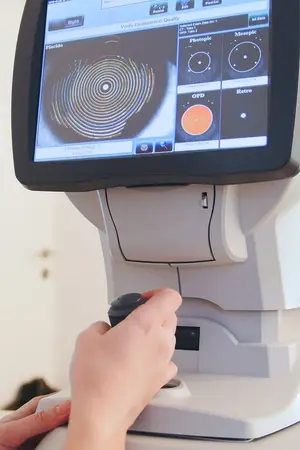
Eye Rx locations share a common set of core diagnostics, so patients receive a similar level of evaluation regardless of where they are seen. This includes digital phoropters for precise refraction, corneal topography for lens fitting and irregularities, and imaging platforms that support early detection of ocular disease. These tools help us document baseline findings, track progression, and provide detailed reports that are easy to integrate into your own records.

Consistency Across a Connected Network
Because Eye Rx practices use aligned technology and testing protocols, results are comparable across offices. A patient imaged with Optomap or OCT in Chevy Chase can be followed just as reliably in Washington, D.C., Arlington, Stone Ridge, Dumfries, or Lansdowne. This consistency supports continuity of care for patients with medical eye conditions, busy schedules, or changing addresses, and gives partner optometrists confidence that the information they receive is reliable across locations.
Optomap Ultra-Widefield Imaging
Optomap allows us to capture a detailed view of the retina in seconds, helping detect early signs of disease that may not yet cause symptoms. This technology supports more informed clinical recommendations across our entire network.

OCT for Precision Diagnosis
Optical Coherence Tomography (OCT) provides cross-sectional imaging of retinal and optic nerve structures. This level of detail helps our doctors monitor glaucoma, macular degeneration, diabetic changes, and other conditions with accuracy, supporting confident decision-making and collaborative care.
Meibography & Dry Eye Technology
Optical Coherence Tomography (OCT) provides cross-sectional imaging of retinal and optic nerve structures. This level of detail helps our doctors monitor glaucoma, macular degeneration, diabetic changes, and other conditions with accuracy, supporting confident decision-making and collaborative care.
You receive structured reports that outline changes over time, highlight risk indicators, compare imaging against previous studies, and offer clear recommendations for co-management or return to your care. Our aim is to complement the work you already do and make shared decision-making easier.
Technology Designed for Clinical Confidence
When you join the Eye Rx network, you gain access to a technology platform built for careful, medically focused eye care. From Optomap and OCT to meibography, Pentacam, and IPL/RF, our diagnostics are selected to answer meaningful clinical questions, not just generate images. This foundation supports accurate diagnoses, clearer patient education, and more informed decisions for every stage of care.
Technology That Enhances, Not Replaces, Clinical Expertise
Our diagnostic tools provide valuable insight without overshadowing patient interaction or clinical judgment. Each test creates a clear opportunity to explain findings in practical terms. This approach reinforces patient confidence and strengthens the trust they place in both their primary optometrist and our diagnostic team.
Let’s Strengthen Patient Care Together
For optometrists seeking a reliable diagnostic partner, Eye Rx provides medical expertise, modern technology, and a transparent, supportive process. We work alongside you to enhance clinical outcomes, elevate the patient experience, and ensure continuity of care with consistent, medically grounded evaluations.
Built for Practices That Value Autonomy
Eye Rx offers a structure where independent practices can thrive without losing their identity or clinical judgment. Our network supports eye doctors through aligned medical standards, shared resources, and a collaborative team environment designed to preserve autonomy while easing operational demands.
When you refer a patient, you need clarity. Our diagnostic platforms capture subtle changes, compare historical data, and produce reliable, interpretable results. Each image and measurement deepens our understanding of the patient’s condition and informs ongoing management.
This precision strengthens collaboration and supports informed decision-making for our eye doctors and partners.